After I Die, Leave the Ashes to Freedom — On Ritual, Remains, and Immortality
April 6, 2026 - By Homer Shie
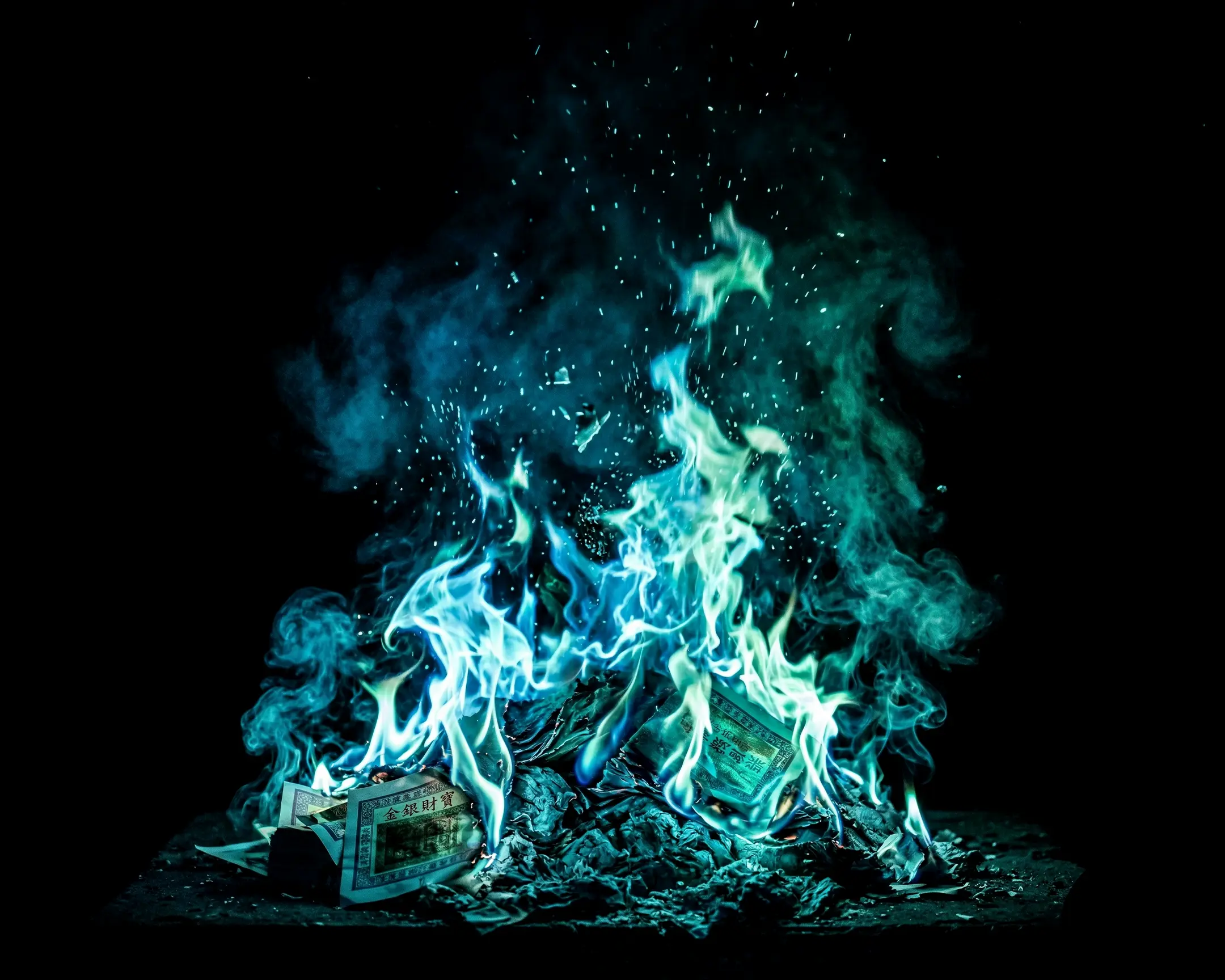
It's Qingming season again, and the air carries that familiar blend of incense paper ash and damp earth. For someone like me — someone who habitually dissects the world with logic — ritual has always carried an inexplicable sense of absurdity. Praying to an uncertain recipient for an uncertain future feels like feeding coins into an unplugged vending machine, hoping it dispenses the drink you want.
But in this late-night dialogue with Claude, I discovered that beneath this "redundancy" lies a deep fear of dependence, existence, and being a burden to others.
I. What Is Ritual For?
I've felt a strange detachment from ancestor worship since childhood. On one hand, there's the absurdity of praying to the unknown — we can't confirm whether consciousness exists after death, yet we assume the departed will receive incense and paper money. On the other hand, there's the passive nature of participation — nobody asked if I wanted to come; when the time arrived, I simply had to.
As I grew older, I rationalized it as "formalistic respect" and assigned it the meaning of "family socializing" and "shared emotional labor." I go to pay respects because my brother handles the offerings and I don't want him to carry that responsibility alone; I go to collect fragments of family history — stories of someone marrying into our lineage and putting down roots. At that point, the ritual's meaning had completely shifted from "serving the dead" to "serving the living."
We can never verify whether the dead are truly served. But the living can — through ritual, they find psychological comfort, process regret, or simply have a reason to gather the family together. Ritual is fundamentally a psychological mechanism for the living, merely packaged as a gift for the dead.
II. The Anchor of Identity
Claude surfaced an angle I hadn't considered: the function of ritual as an "identity anchor."
My family is Hakka, and the history before coming to Taiwan from China has been lost. I only know that the patriarch originally bore a different surname and, for reasons now forgotten, married into our family — and that's how we gradually took root in Taiwan. I heard this story at a ritual gathering, finding it curious at the time.
But I kept thinking: does modern relationship-building really still require ritual to sustain it? With communication tools so advanced, anyone who genuinely wants to know their family history won't wait until those two hours on Qingming to ask. And memories beyond three generations naturally fade — what was my great-great-grandmother's name? Nobody knows. The ancestral tablet might have it written down, but that's just text, not a person.
III. The Age of Mass Death: The Materiality of Remains
Recently I came across reporting on Japan's "super-aging society." The surge in deaths from an aging population has created crematorium queues stretching over a week, giving rise to "body hotels" — facilities designed to temporarily store remains while awaiting cremation slots. Some families have had to keep their loved ones' bodies at home for a time.
The image is jarring: the "ought" of traditional ritual and the "is" of society's processing capacity are coming apart. We believe remains should be treated with solemnity, but when death becomes a mass, concentrated event, the system simply can't give each body adequate "solemnity."
This led me to a more fundamental question: Where does our fixation on remains come from?
Rationally, I know a body is biological matter, no different in essence from any other creature's death. But if someone said "throw a loved one's remains in a landfill," my instinct would still recoil. Claude put it precisely: "Even if we can't confirm whether a soul exists, our bodies and emotions still treat remains as, in some sense, 'that person.'"
This contradiction is probably a trace left by biology and sociality — recognizing the remains of one's kind, maintaining group cohesion, honoring those who have passed. Only now these traits are beginning to conflict with practical realities.
IV. Forms of Immortality: Being Remembered
As the conversation deepened, I realized the deeper reason ritual holds no feeling for me: I've already been using another system to address the need to "be remembered."
The logic of traditional ritual is that "being remembered after death" depends on descendants performing ceremonies — a passive, bloodline-dependent form of "immortality." But I believe the trace of a life can be recorded somewhere outside the body: articles, work, projects, the influence left in other people's minds. This is an active "immortality" that doesn't depend on anyone to maintain.
Claude challenged me: isn't this "a privilege of those with resources"? Because I have the capacity to create things worth remembering, I can casually say I don't need ritual. But for most people living ordinary lives, ritual may be the only mechanism they have for remaining in this world.
Even so, this only means that choices have costs — it ultimately comes down to one's personal goals in life. I won't deny others' choice to be remembered through ritual, but for myself, I'd feel that it burdens others — demanding descendants give time and attention, becoming an annual "duty and obligation."
V. Not Wanting to Be Anyone's Burden
Claude traced a hidden thread: the underlying value of "I don't want to owe anyone, and I don't want anyone to owe me."
This aligns with my core disposition — not wanting to fit into institutions, not wanting to owe favors, hoping everyone can look after themselves without needing others. Psychologically, it probably falls somewhere on the "avoidant attachment" spectrum; philosophically, it resembles the Stoic ideal of self-sufficiency. Though a few relationships and friendships have loosened this conviction somewhat, its core — treating "not troubling others" as a virtue — remains intact.
Claude reminded me: "Letting others hold your vulnerability is sometimes a form of giving."
The day after a recent breakup, I was at the hospital watching over my father. When my mother came to relieve me, I told her I'd broken up with someone — and unexpectedly broke down crying. In that moment, I had inadvertently "burdened" her. And that may have indirectly sent a signal of being needed. I gave her the chance to comfort me in her own way. If I refuse all burdens, all rituals, I'm also stripping away the opportunity for those who love me to express that love.
Conclusion: After I Die, Leave the Ashes to Freedom
I still find traditional ritual cumbersome and unnecessary — but I've learned to participate in it from a more "meta" perspective. I don't believe in spirits, but I believe in connection. I don't seek blessings, but I'm willing to share the weight.
When I die, I want to be cremated. Scatter the ashes in the ocean, send them up in a balloon to drift on the wind, or just flush them down the nearest drain. No grave, no ancestral tablet, no one who feels they "should" visit me each year. I don't need to be honored in ritual because I'm already leaving traces through other means — and if those traces hold no value, ritual won't preserve anything either.
I won't deny the meaning ritual holds for others. For some people, it's a reason for family to gather, a ceremony for processing regret, a way to maintain the narrative of identity. These are all real functions.
For me, the core problem with ritual is that it hands the responsibility of "being remembered" to someone else. And I'd rather hold that responsibility myself — creating something worth remembering while alive, and asking for no one's attention after death. Returning space to the world, returning time to those who come after.
Perhaps that's a kind of arrogance. Or perhaps it's a kind of consideration. In the end, it probably comes back to how each of us defines the value of a life.